
How to Calculate Your TDEE (And Why It's the Foundation of Every Diet)
MacroM8 Team
2 April 2026 · 4 min read
What is TDEE and why does it matter?
Your Total Daily Energy Expenditure (TDEE) is the total number of calories your body burns in a day — everything from keeping your heart beating to crushing a workout. It is the single most important number in nutrition because every goal you have, whether that's losing fat, building muscle or simply maintaining your weight, starts here.
Without knowing your TDEE, you are essentially guessing. And most people guess wrong — which is exactly why so many diets fail within the first few weeks.
TDEE vs BMR — what's the difference?
You may have heard the term BMR (Basal Metabolic Rate) thrown around. Your BMR is the number of calories your body needs just to survive — breathing, circulation, cell repair — at complete rest. Think of it as the minimum your engine needs to idle.
Your TDEE builds on top of your BMR by accounting for everything else you do during the day: walking to the car, sitting at a desk, training at the gym, fidgeting. TDEE is always higher than BMR, and it's the number you actually need to plan your nutrition around.
The Mifflin-St Jeor formula (the most accurate method)
There are several formulas used to estimate BMR, but research consistently shows the Mifflin-St Jeor equation is the most accurate for most people.
For men:
BMR = (10 × weight in kg) + (6.25 × height in cm) − (5 × age) + 5
For women:
BMR = (10 × weight in kg) + (6.25 × height in cm) − (5 × age) − 161
Once you have your BMR, multiply it by your activity multiplier to get your TDEE:
Sedentary (little or no exercise): BMR × 1.2
Lightly active (1–3 days/week exercise): BMR × 1.375
Moderately active (3–5 days/week): BMR × 1.55
Very active (6–7 days/week hard training): BMR × 1.725
Extremely active (physical job + daily training): BMR × 1.9
A worked example
Let's say you're a 30-year-old woman, 65 kg, 168 cm tall, and you train 4 days a week.
BMR = (10 × 65) + (6.25 × 168) − (5 × 30) − 161 = 650 + 1050 − 150 − 161 = 1,389 calories
TDEE = 1,389 × 1.55 = approximately 2,153 calories per day
This is your maintenance — the number of calories that keeps your weight exactly where it is.
How to use your TDEE to hit your goals
Once you know your TDEE, adjusting for your goal is straightforward:
Fat loss: Eat 15–25% below your TDEE (a moderate deficit of around 300–500 calories per day is sustainable and preserves muscle mass)
Muscle gain: Eat 5–15% above your TDEE (a lean bulk of 200–400 calories surplus minimises fat gain)
Maintenance: Eat at your TDEE
Why TDEE is just an estimate
It's important to understand that any TDEE formula gives you a starting estimate, not a precise measurement. Variables like hormone levels, gut health, sleep quality, and non-exercise activity (how much you fidget, walk around, etc.) all influence your actual expenditure.
The right approach is to use your calculated TDEE as a starting point, track your food and body weight for 2–3 weeks, and adjust from there. If you're eating at your calculated TDEE and still gaining weight, reduce calories slightly. If you're losing weight faster than intended, add some back in.
Track your macros around your TDEE with Macro M8
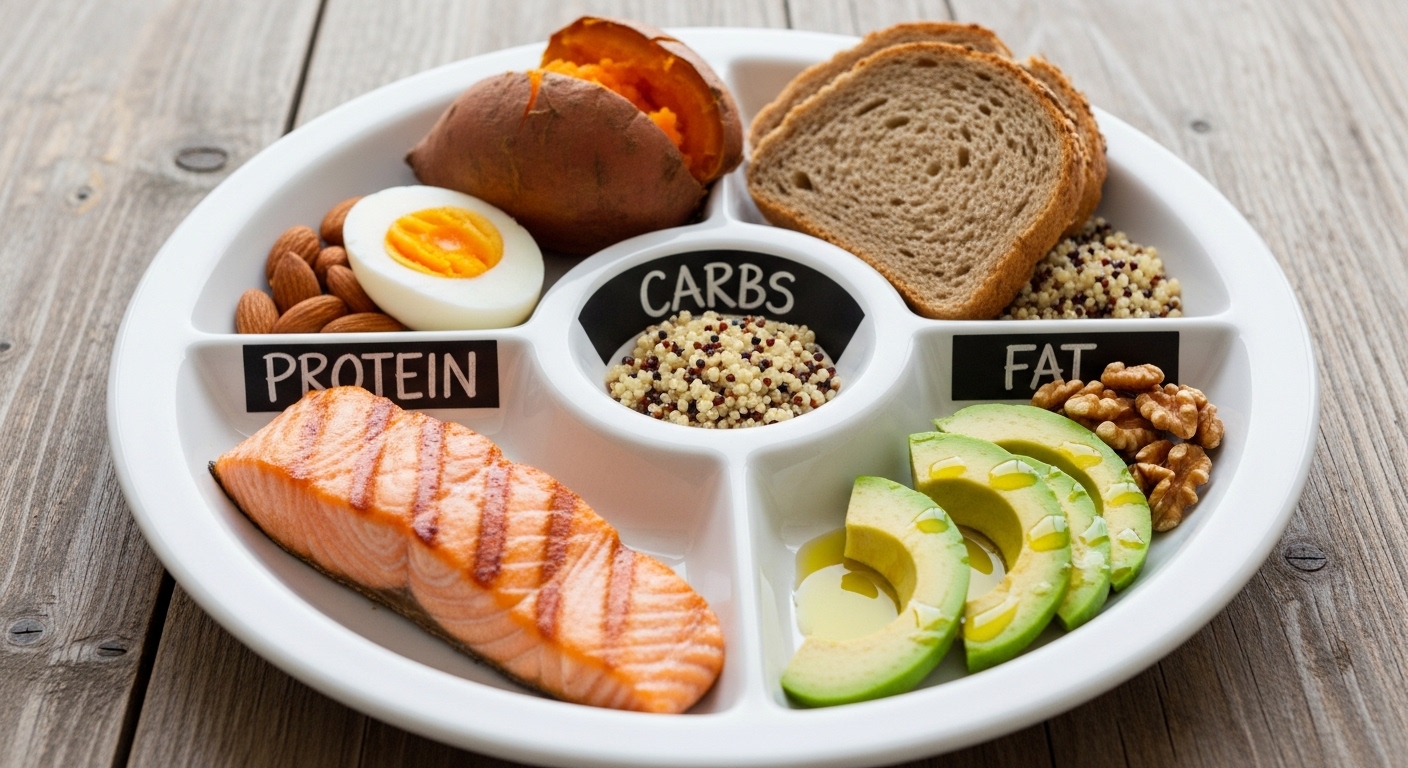
Knowing your TDEE is only half the equation. The other half is understanding how to split those calories across protein, carbohydrates and fat — your macronutrients. Macro M8 uses your personal data to calculate your TDEE and automatically suggests macro targets so you can start tracking immediately, without needing a nutrition degree.